

Your team just had a big win. They successfully filled 25 staffing positions for an important client.
Is that something you can turn into a solid case study? Sure. But will it end up being a truly great case study? Maybe.
To make it great, you have to focus on the narrative and what success was defined by. The high number of placements achieved isn’t necessarily what makes the story compelling.
For staffing and workforce solutions companies, the strongest case studies go deeper. They show what happened beyond the placement itself: the unique business problem the client needed to solve and why they turned to you, why it mattered to change their workflows and long-term goals, what your team did differently to close gaps and address pain points, and what positive impact stemmed directly from your work.
This vantage point makes the story you tell about why your client needed your help interesting, relatable, and one you remember, reports The American Staffing Association, is a major trend affecting staffing firms. But finding new clients was staffing companies’ top reported challenge in 2025.
When buyers have dozens of firms telling them they can “find great talent,” simply saying you filled positions doesn’t help you stand out from the competition
Showing how you helped a client solve a difficult business problem is.
Why Case Studies Matter More When Staffing Firms Are Selling More Than Staffing
Traditional staff augmentation will always be an important part of the staffing industry.
But many firms are thinking differently about how they can support clients in new ways.
Alongside contract, contract-to-hire, and direct hire services, staffing companies are increasingly delivering workforce consulting, managed services, project-based teams, specialized delivery models, and other solutions designed around broader business challenges.
Those engagements create an opportunity to tell a different kind of story. But even a traditional staffing engagement can make a strong case study when you look beyond the placements and uncover the business impact behind them.
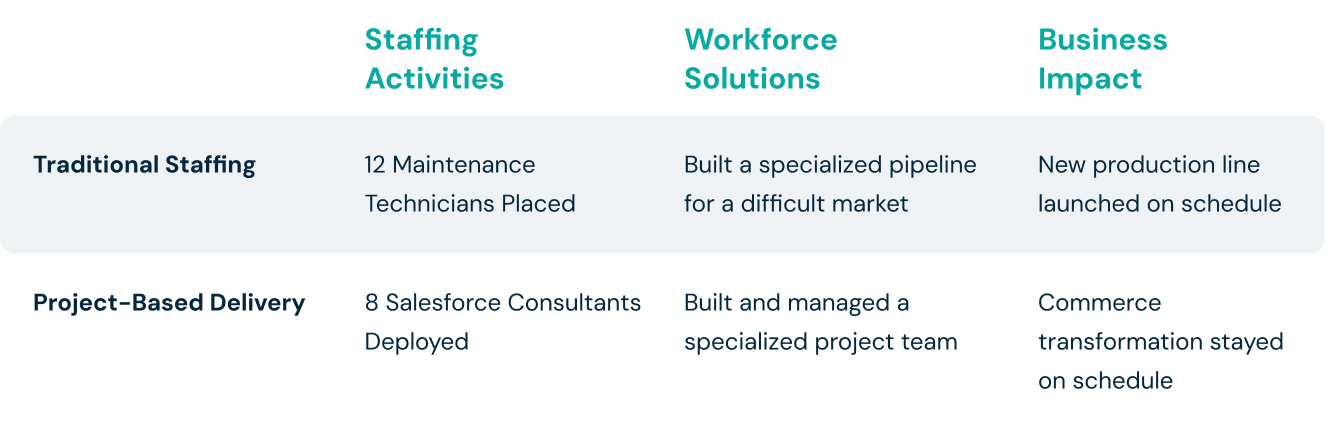
The Real Question: What Changed for the Client?
A strong case study should help a prospective client understand five things:
- What seemingly impossible problem was the client facing?
- Why was it difficult for the client to not have a holistic vantage point on how to drive change without you?
- What did your company do, and what “aha” moments did you spark for the client?
- What changed as a result, and what learnings for the client along the way popped up?
- Why did your approach matter?
That means some seemingly impressive engagements won’t make particularly compelling case studies. It’s about the humanized elements where things like critical thinking, executive mindset shifts, workflow reorganizations, and leveraging different tools and strategies the client themselves didn’t have an awareness of. And piecing all that together into a well-organized and linear narrative that puts the person digesting this case study right in that client’s shows to trust you can achieve the same impact for them, too.
And some smaller engagements will do just this. The determining factor isn’t necessarily the size of the deal.
It’s the strength of the story. The 25 filled staffing positions are just a number. It’s how you got there that sticks in people’s minds. Remember that perhaps another case study exists where you filled only 13, but the journey to get there was more urgent, more high-risk, more unexpected, or more complex. Those are the stories others desire to hear.
5 Signs You’ve Found a Strong Case Study Opportunity
1. There Was a Meaningful Business Problem
Look beyond the job order.
Why did the client actually need those people?
Perhaps they needed to meet a product launch, expand into a new market, support a major implementation, address an internal skills gap, or scale faster than their internal team could support.
That’s the beginning of the story.
2. The Engagement Involved Real Complexity
Specialized skills. Multiple locations. Aggressive deadlines. Changing requirements. Regulatory considerations. Multiple stakeholders.
Complexity gives you an opportunity to demonstrate expertise and strategic thinking rather than simply well-timed or lucky execution.
3. Your Team Did More Than Source Candidates
This is particularly important.
Did your team challenge the original requirements? Recommend a different delivery model? Build a dedicated project team? Coordinate multiple workstreams? Develop a specialized talent pipeline? Adapt the strategy when priorities changed? Was there pushback? Was there surprise or an emotional reaction at any stage? Did your work help a client think about their mission differently or who they serve and why in a new light?
That’s your differentiation.
4. You Can Show What Changed
The strongest proof isn’t always a placement count.
Look for:
- Reduced time-to-fill
- Project deadlines met
- Cost or time savings
- Improved productivity or capacity
- Retention
- Faster launch or implementation
- Risk avoided
- Additional locations supported
- Expansion of the client relationship
Exact metrics are ideal, but directional outcomes can still tell a strong story.
5. Another Buyer Would Recognize the Problem
This may be the most important test of all.
Ask:Would one of our target prospects read this and think, “We’re dealing with that too”? And, “We don’t yet know how to solve this problem, and we still need help beyond what we can do ourselves.”
If the answer is yes to all, you’ve probably found a story worth developing.
Don’t Wait Until Marketing Needs a Case Study
One of the biggest case study mistakes happens long before anyone starts writing.
The story isn’t captured while it’s happening.
Six months later, nobody remembers the original timeline. The recruiter doesn’t have the numbers. The account executive vaguely remembers the client’s challenge. And the perfect client quote and stats were never requested.
Make identifying potential case study components part of your account management process.
When an engagement produces a meaningful outcome, flag it while it’s in action, not after the fact
You can decide later whether it deserves to become a finished asset. Have a sharp eye for when early potential has the ability to potentially explode down the road.
Start With the Right Opportunities
Before you spend time interviewing stakeholders, tracking down metrics, getting client approval, writing copy, and designing an asset, make sure the story is worth the investment.
We’ve created a simple resource specifically for staffing and workforce solutions teams to do exactly that.
FREE DOWNLOAD: Case Study Opportunity Checklist
Use the checklist with your sales, recruiting, account management, and marketing teams to quickly evaluate whether a client engagement has the ingredients of a strong case study.
Already have a strong case study opportunity?
The next challenge is capturing the right information and turning it into a story prospects will actually care about. Read Part 2: How to Build a Staffing Case Study That Actually Proves Your Value.