
Imagine this. Your top client is thrilled with the impact you’ve helped them achieve. But not only that. You have tangible results in hand to prove to others why they first came to you for help, how your expertise transformed their business, and how this impact stuck around for good.
Word gets out. Your marketing team hears one line over and over whenever this client’s name comes up in conversation:: “We should make a case study out of this.”
No one disagrees. But what’s the next step? Not only to ensure you write a case study out of this wonderful scenario, but also a great one that attracts new happy clients over time.
For many staffing firms, capturing a strong client story is complex.
Information for your case study gets passed piecemeal to marketing in bits and pieces, often without full context. Someone sends over the number of placements. They’re very high. Another person remembers the timeline. It was impressive. But nobody asks why the engagement mattered to the client’s business.
Eventually, the finished case study becomes three pages of dry, inhuman copy explaining what the staffing company did.
But the most important part of the story gets buried: What changed for the client?
First things first: Is this actually a case study?
Not every successful engagement warrants the time and resources required to develop one. If you’re still deciding whether there’s a strong enough story, start with Part 1: How to Identify a Great Staffing Case Study Opportunity and download the free Case Study Opportunity Checklist.
Case Studies Are Proof, Not Just Content
Customer stories remain such an important B2B marketing format.
Content Marketing Institute’s 2025 B2B research found three in four of B2B marketers use case studies/customer stories, and over half said they were among the content types producing the best results, second only to video.
That makes sense, on the surface. Both case studies and videos are vehicles to tell stories.
Your website tells prospects what you can do. Your case studies show them what you’ve already done.
For a staffing or workforce solutions company, that’s particularly powerful when you’re selling something more complex than filling an opening. You’re also selling the journey, the pushback, the actionable data insights, the results of tough or unexpected conversations, and that messy yet beautifully complex “middle” part of the infamous “before-and-after” transformation many companies skip over.
Start With the Business Problem, Not the Staffing Request
One of the easiest mistakes to make when developing a staffing case study is starting with the job order.
“The client needed 15 developers.”
That’s useful information, but it doesn’t tell us why the engagement mattered. Why were they short on developers? Was it something in their control? Was there an urgency? For what reasons were they not there already by the time you stepped in to assist?
The strongest case studies keep digging until they connect the talent need to the business problem behind it.
What does this look like in action? It’s a very similar mindset, perhaps, to the “Jobs to be Done” theory. This famously states that customers don’t buy products like a hammer and nails. People buy both to achieve a specific outcome. For example, maybe to hang a picture on a wall. In that case, you’re not selling a hammer and nails to a client. You’re selling, say, assisting an elderly man who moved into a new apartment and wants to hang a photo of his family above the mantel. He makes a purchase because he needs the right tools to achieve his desired outcome so he can be reminded of his loved ones each day.
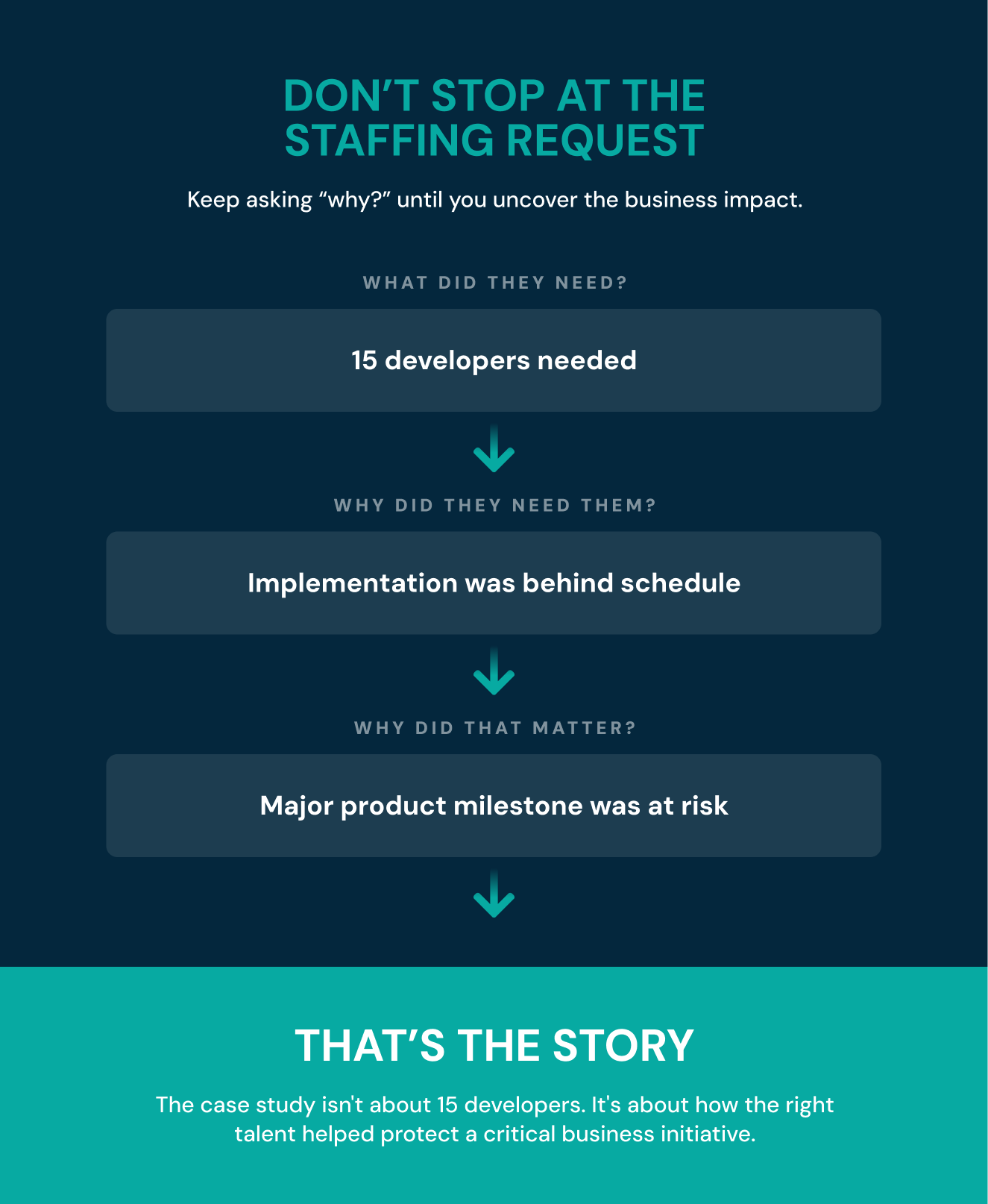
That’s the difference between documenting a staffing engagement and telling a client success story.
The first tells prospects what you delivered.
The second shows them why your work mattered.
The 5 Things Marketing Needs to Build a Strong Case Study
Once you’ve determined the engagement is worth turning into a case study, the next step is capturing the information that will make the story something you remember long after it’s told.
1. The Challenge
Understand what was happening before your company entered the picture.
Ask:
- What was the client trying to accomplish? What was their vision when their goal was achieved?
- What problem was getting in the way? What did they need that they didn’t have access to or an understanding of?
- Why did it matter?
- Why was it urgent and for whom?
- What would happen if they didn’t solve it?
2. The Scope and Complexity
This establishes why the engagement wasn’t easy.
Capture roles, skills, locations, timelines, stakeholders, certifications, workstreams, and anything else that made the work particularly challenging.
3. Your Approach
This is where too many staffing case studies don’t go deep enough
“Our recruiters sourced and screened qualified candidates.”
That’s expected.
Instead, uncover what your team did that demonstrates how you think and solve problems.
Did you refine the requirements? Build a specialized delivery team? Recommend a different workforce model? Improve communication? Develop a new pipeline? Change course when priorities shifted? Define a new hiring process step? Identify a new candidate criterion you’d formerly overlooked or not considered due to “not knowing what you don’t know”?
That’s what gives prospects a reason to choose you over another staffing provider.
4. Results and Business Impact
Placements matter. But they’re only one category of result.
If your current Intake Questionnaire does an especially good job separating People/Hiring metrics from Business/Project Impact, preserve that distinction in the final resource.
Capture both:
- Hiring outcomes – Time to first candidate, time-to-fill, hires, retention, offer acceptance.
- Business outcomes – Deadlines achieved, capacity added, costs reduced, risks avoided, launches enabled, productivity improved, relationships expanded.
Then ask one final question: What changed for the client because of our partnership?
That’s often where the strongest headline comes from. This can also tie into culture, i.e. how workplace tasks shifted, how new insights redefined ways of working, how processes shifted to streamline daily operations, and/or how data findings sparked new insights into closing gaps.
5. The Client’s Perspective
Numbers provide proof. The client’s voice provides credibility.
Instead of asking a generic question like “Can we get a testimonial?” ask:
- What did working with us mean to you regarding how it changed your role or team?
- What made your job easier?
- What stood out about working with our team?
- What were you able to accomplish that you couldn’t before because of the partnership?
And don’t abandon the case study simply because the client can’t be named.
A strong anonymous story such as “A Leading National Data Center Developer in the Midwest” can still be useful when the problem, approach, and results are specific enough to establish credibility. Your questionnaire already anticipates this well. The reader of the case study will fill in all gaps themselves and make inferences without having each detail in hand. This ensures you can protect anonymity and ensure you don’t have a client decline a case study who’d otherwise be a fantastic storytelling option.
Then, Make It Easy to Read
Gathering the right information is only half the job. How you present it matters too.
Your prospects don’t need a chronological history of the engagement. They need to understand the story quickly.
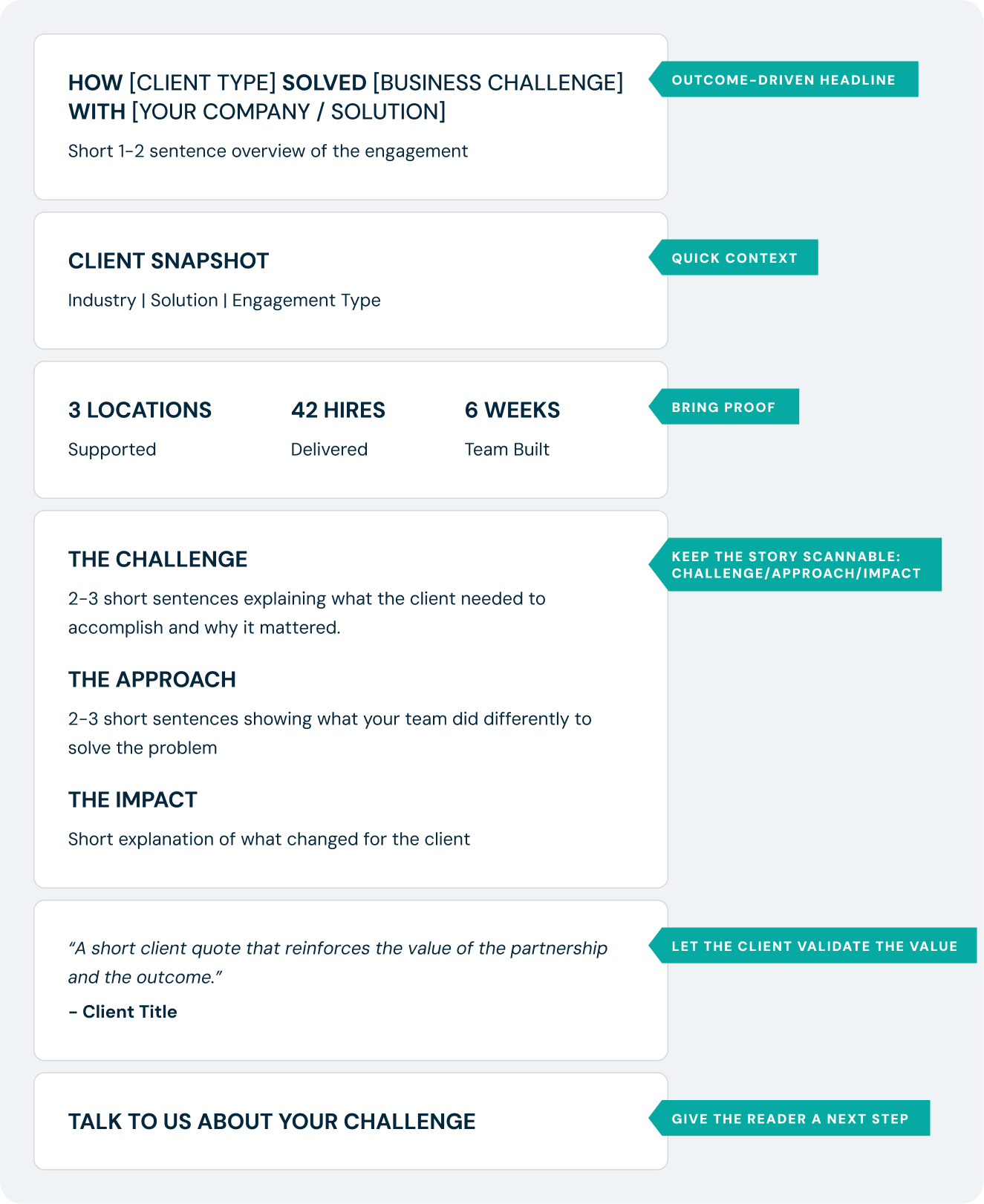
A prospect shouldn’t need to read the entire case study to understand why the
engagement mattered. They should be able to scan and get a quick overview of what happened.
One Case Study. More Than One Use.
Don’t let a strong story live on one forgotten webpage.
The same case study can support:
- Website service and industry pages
- Sales presentations
- Proposals and RFPs
- LinkedIn posts
- Email campaigns
- One-page sales PDFs
- Social media posts
- Flyers with QR codes
- Testimonials that turn into pre-recorded podcasts or on-demand webinars
- Business development conversations
That’s when a case study stops being “content” and starts becoming sales proof.
Make the Intake Easier
That’s why we’ve created a Case Study Intake Questionnaire specifically for staffing and workforce solutions companies.
It gives sales, recruiting, account management, delivery, and marketing teams a consistent framework for capturing the challenge, complexity, approach, outcomes, client perspective, and permissions marketing needs to develop the story.